How to Play
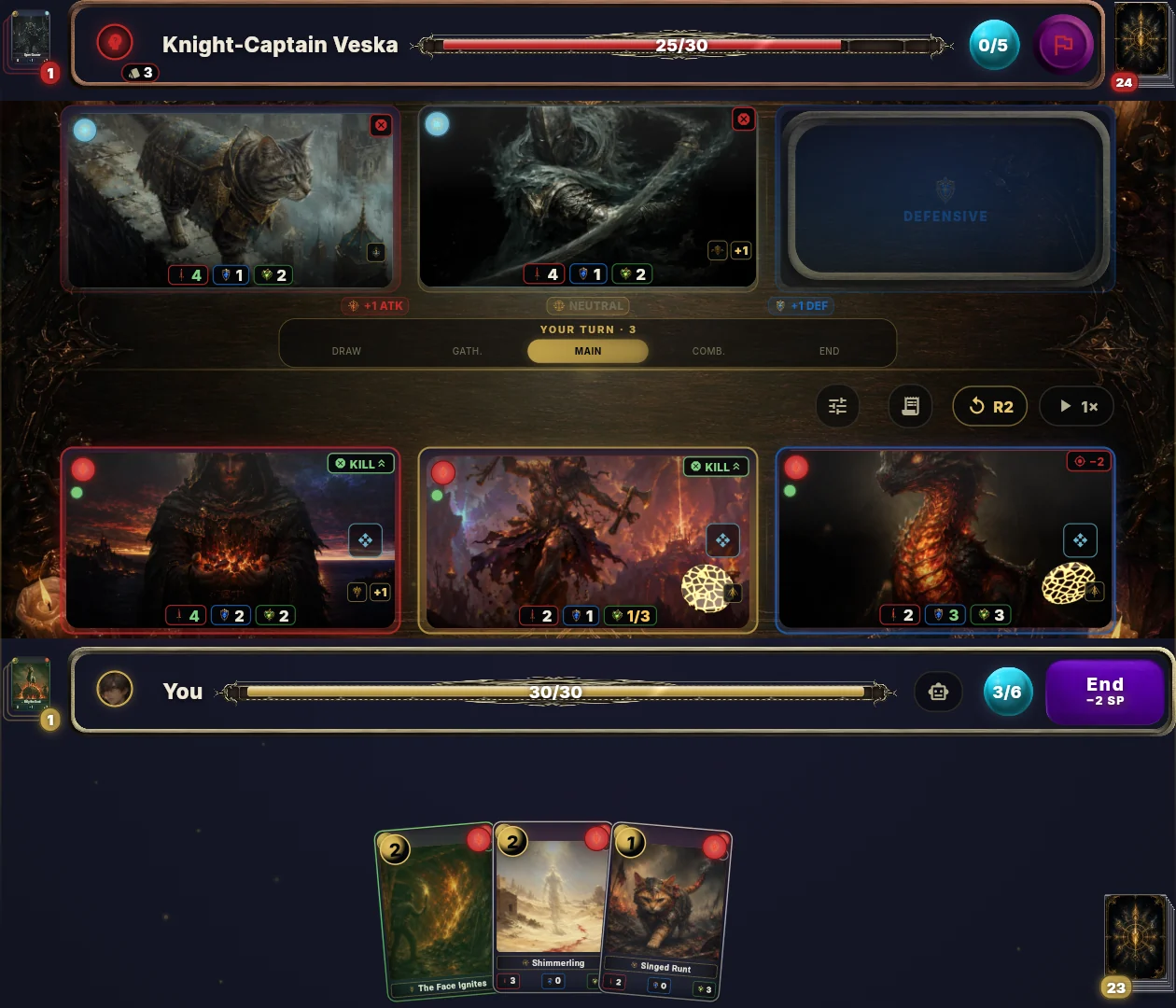
A duel is two players, two 30-card decks and three lanes. You spend Aether to summon units and cast spells, units fight the enemy facing them at the end of your turn, and the first side to run out of Soul Points loses. This page covers every rule, with the exact numbers the game uses.
The duel at a glance
Starting a match
- Both decks are shuffled and each side draws 4 cards. You also draw at the start of your first turn, so you play that turn with 5.
- The opening roll decides who goes first. Each side rolls a six-sided die and the higher roll takes the first turn. Ties are rerolled, so there is always a clear winner. There is no bonus for going second.
- You may mulligan once. Before anyone has played anything, you can shuffle your opening hand back into your deck and draw a fresh 4. The whole deck is reshuffled, so a card you sent back can come straight back. The offer closes the moment anything happens on the board.
Aether: your resource
Aether pays for every card. You start with 3 Aether and gain 1 more at the start of every turn, so you have 4 on your first turn, 5 on your second, and reach the cap of 10 on your seventh. Your Aether refills at the start of each of your turns, so anything you don't spend is lost.
The blue orb next to your Soul bar shows what you have left this turn, for example 4/8 means 4 left out of 8. Cards you can't afford are dimmed in your hand.
"This is your Aether, the power you spend to summon. It refills and grows by one each turn, so your biggest plays come later." Spend small early, swing big later.
Soul Points: your life
Each side starts with 30 Soul Points (some modes and weekly twists change this). Unblocked attacks, Requiem, some spells and fatigue take Soul Points away. Drop your opponent to 0 and you win.
A few effects can heal Soul Points, but never above the amount you started with.
Turn order
The phase tracker in the middle of the board shows where you are in the turn: Draw → Gather → Main → Combat → End.
| Phase | What happens |
|---|---|
| Draw | You draw 1 card. If your hand is already full (7 cards), the drawn card is scorched: it goes straight to your discard. If your deck is empty you take fatigue damage instead (see below). |
| Gather | You gain 1 Aether (up to 10) and your Aether refills. Start-of-turn effects happen here: growing units grow, Ensemble bonuses update, and start-of-turn Decrees fire. |
| Main | Your turn to act. Summon units, cast spells, play a Decree, bind Sigils, and Maneuver units between lanes, in any order, as long as you have the Aether. |
| Combat | When you press End, each of your ready units attacks, lane by lane (Aggressive, then Balanced, then Defensive). |
| End | End-of-turn effects resolve: Burn and Toxin tick, Augury draws, Ephemeral units return to hand, Solitary checks. Then it is your foe's turn. |
The three lanes
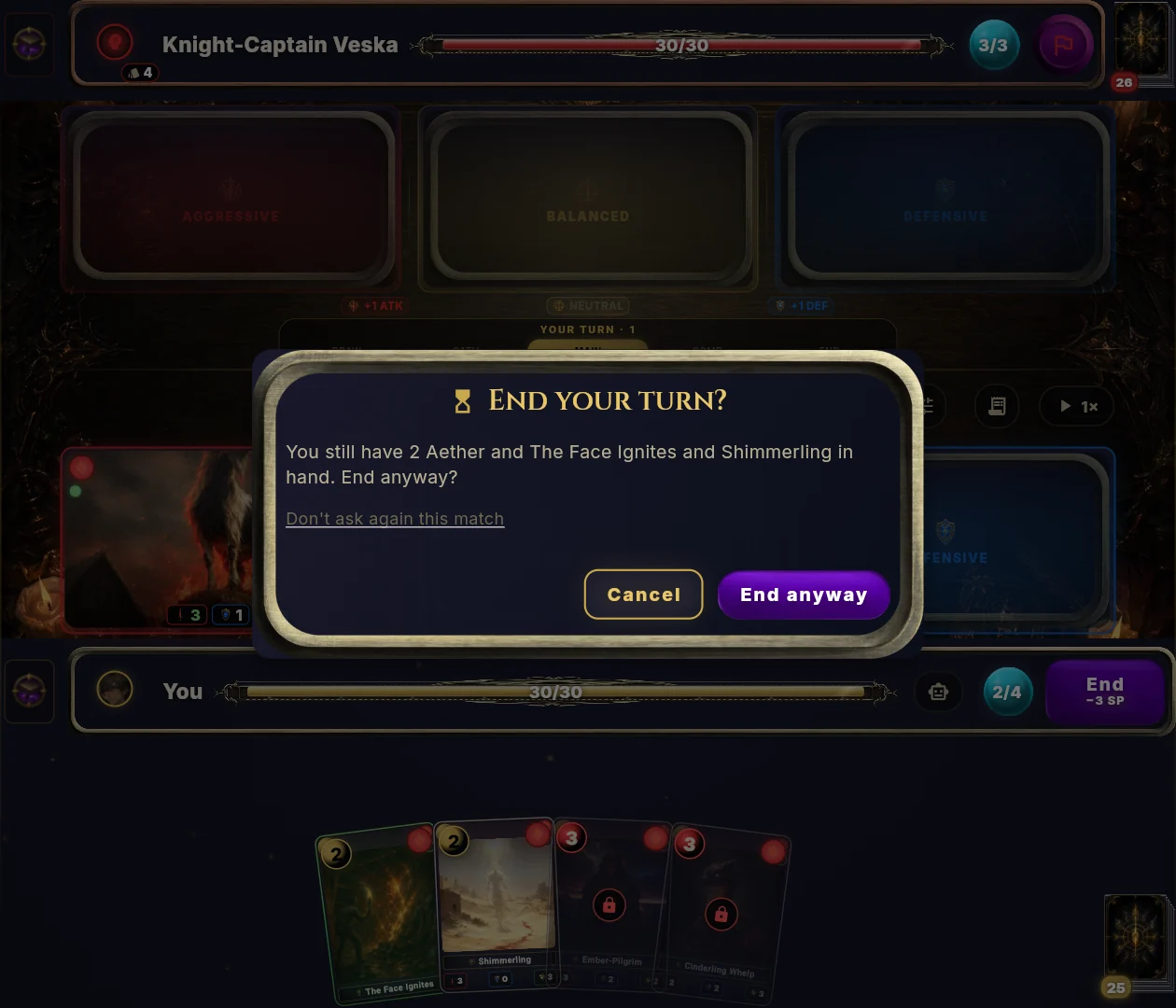
Each side has three lanes, and each lane holds one of your units. Units only ever fight the enemy unit directly across from them.
 Aggressive
Put your hard hitters here. The left lane, outlined in red.
 Balanced
The neutral middle lane, outlined in gold.
 Defensive
Put your walls here. The right lane, outlined in blue.
The bonus belongs to the lane, so a unit gets it for as long as it stands there and swaps it when it moves. Units with Crest get an extra +1 in their matching lane. Tokens created by card effects use their printed stats and don't get lane bonuses.
Summoning units
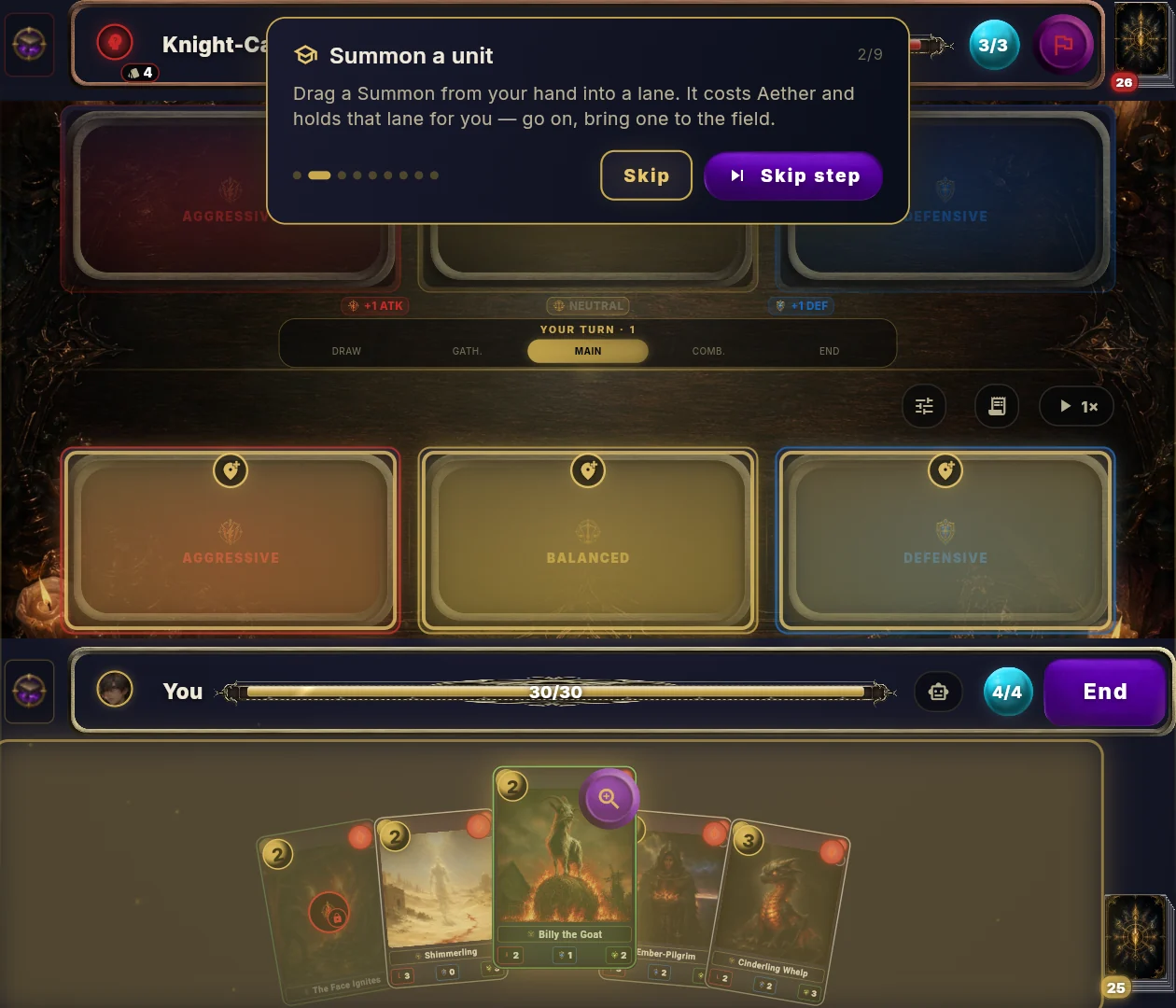
Tap a Summon in your hand, then tap one of your lanes (or drag it there). You pay its Aether cost and it takes the lane.
- A new unit is exhausted the turn it arrives, so it won't attack until your next turn. Units with Vanguard can attack right away. Exhausted units show a small "zzz" mark.
- Summoning into an empty lane is the normal case.
- Summoning onto your own unit is an Eclipse (see below).
Combat
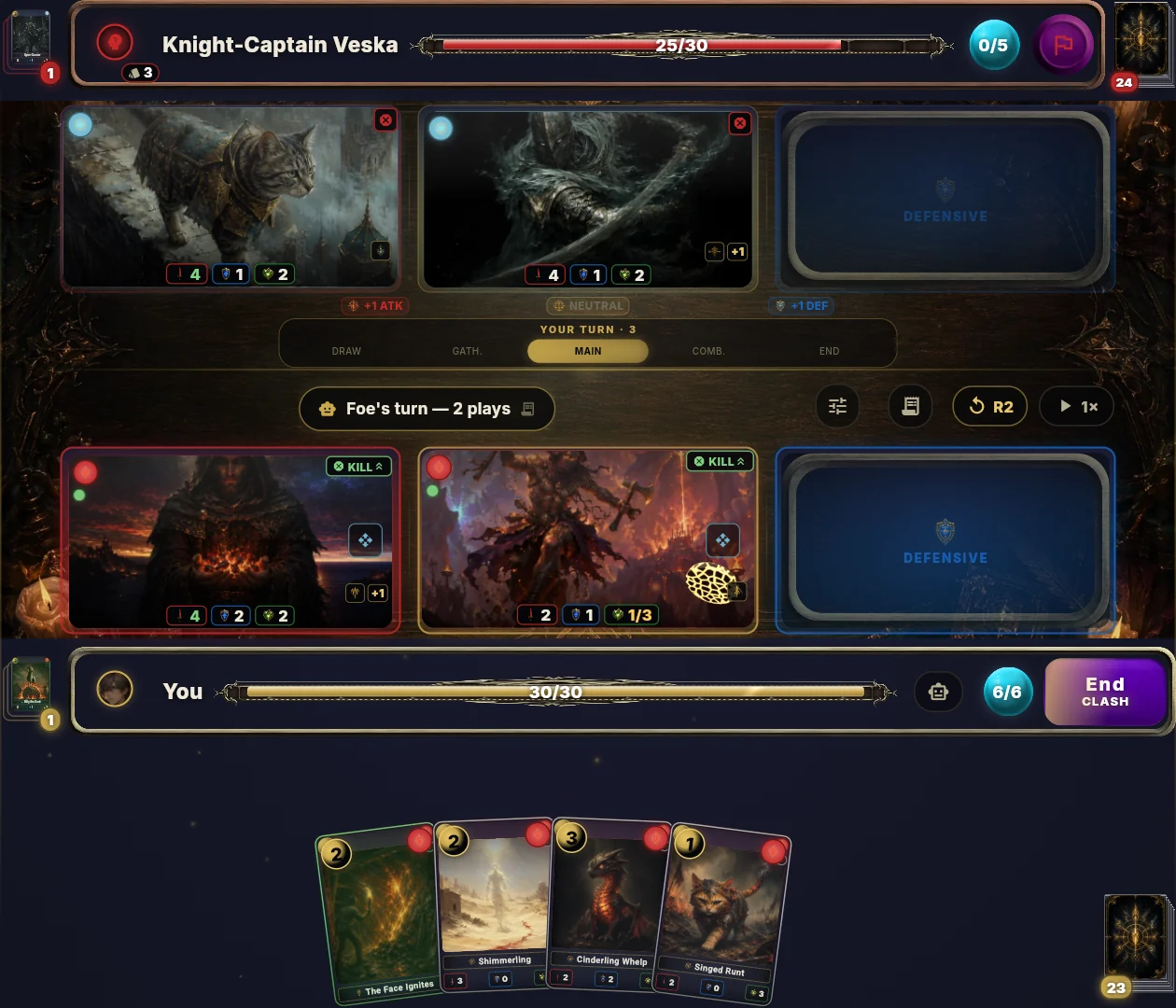
Combat happens automatically when you end your turn. Only your ready units attack on your turn; your opponent's units attack on theirs. Each of your units strikes the lane in front of it:
- If an enemy unit faces it, the two clash.
- If the lane in front is empty, the attack hits the enemy's Soul Points directly for the attacker's full Attack (no element bonus or Defense applies), unless an enemy Bulwark pulls the blow onto itself.
How a clash resolves
- The attacker strikes. Damage = Attack (times the elemental multiplier) minus the defender's Defense.
- Defense can only blunt so much. Defense never blocks more than two thirds of a hit: a strike that connects always deals at least Attack ÷ 3, rounded up. A 7 Attack unit hitting a wall with 10 Defense still deals 3.
- The defender strikes back only if it survives: its Attack (times its own elemental multiplier) minus the attacker's Defense. The counter-blow has no minimum, so it can be 0. Attackers with Pierce or Unseen take no counter-blow.
- Units at 0 Health are destroyed and go to the discard pile. Requiem and other "on destroy" effects fire now.
Your 5 Attack Fire unit (6 in the Aggressive lane) attacks a Wind unit with 2 Defense and 4 Health. Fire beats Wind, so the strike is 6 × 1.25 = 7.5, rounded to 8. 8 minus 2 Defense = 6 damage, and the Wind unit is destroyed. It never gets to strike back.
The strike lands first, so a defender destroyed by it never hits back. Damage to a unit stays on it: Health does not refill between turns unless something heals it. A unit that attacks becomes exhausted until your next turn.
The wall's price
A Bulwark can pull one unblocked enemy attack per turn onto itself, but walls aren't free: every blow a Bulwark takes costs its side 1 Soul Point, whether it pulled the attack across the board or met it in its own lane. An ordinary blocker without Bulwark stops a blow for free.
Shelter does not soak this 1 point (it saves itself for a real hit), with one exception: while Biscuit, Who Holds the Floor stands, Shelter catches every point.
Elements and advantage
Every card has one of six elements. Four of them form a wheel. Attacking the element yours beats deals 1.25× damage; attacking the element that beats yours deals only 0.80×. Light and Shadow sit outside the wheel as sworn rivals: each deals 1.25× to the other, so those fights cut both ways.
| Attacker | Deals 1.25× to | Deals 0.80× to |
|---|---|---|
| Fire | Wind | Water |
| Wind | Earth | Fire |
| Earth | Water | Wind |
| Water | Fire | Earth |
| Light | Shadow | (nothing) |
| Shadow | Light | (nothing) |
The multiplier applies to Summon-vs-Summon clashes only, to both the strike and the counter-blow, each in its own direction. It never applies to direct Soul hits, Requiem, spells, Burn or Toxin. Same-element fights, and Light or Shadow against a wheel element, are even (1×). Bane doubles an advantaged strike on top of the 1.25×.
The element gate
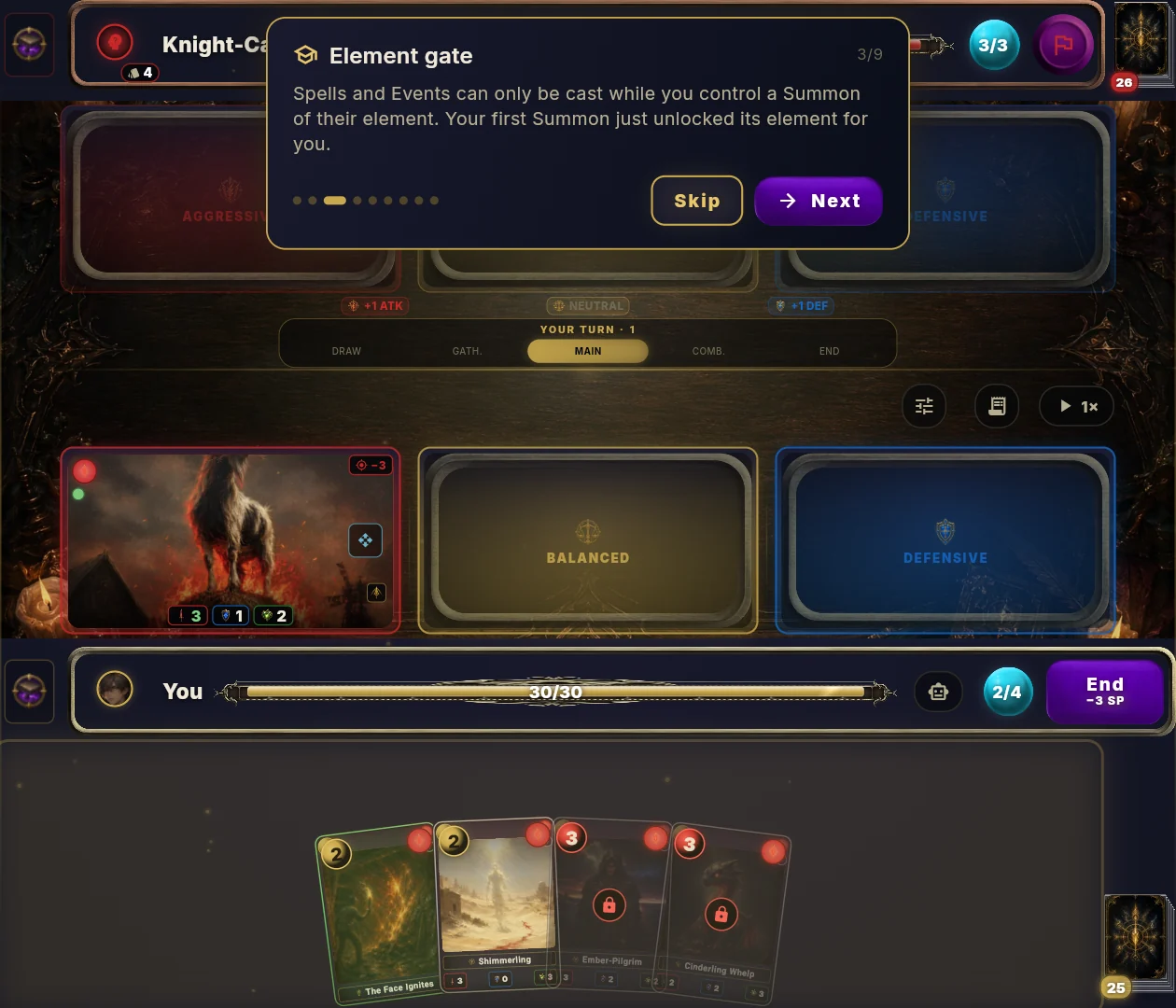
Spells and Events can only be played while you control a Summon of the same element. Without one, the card is locked in your hand and shows a padlock ("Requires a Fire Summon on your field"). A buried unit doesn't count, but a Decree already in play stays even if you lose your matching Summon later. Summons themselves are never gated. This is why most decks lean on one or two elements: your Summons unlock your spells.
The four card types
 Summon
A unit with Attack, Defense and Health. It takes a lane and fights.
 Spell
Spell
A one-time effect: damage, healing, draw, buffs, removal. Needs a Summon of its element.
 Event (Decree)
Becomes a standing Decree with an ongoing effect. You can hold only one: a new Decree replaces the old.
 Sigil
Sigil
Binds to one of your Summons of the same element and buffs it while it stands. Each Summon can carry up to two.
See Cards Explained for how to read each type.
Maneuver: moving units
Drag one of your units on the board to another of your lanes to Maneuver it. It costs 1 Aether, each unit can move once per turn, and a unit that moves is exhausted (it won't attack this turn).
Some cards let a unit move for free. "Maneuvers free" only waives the Aether, so the unit still exhausts. A few rarer cards move a unit "free and it stays ready", so it can still attack. Moving a unit onto another of your units Eclipses it. Wake and Crest reward moving.
Eclipse: stacking your own units
Play or move a Summon onto one of your own occupied lanes to Eclipse it. The newcomer takes the lane with +1/+1, and the old unit is buried beneath it. When the newcomer falls, the buried unit comes back up at the Health it had. A lane can be stacked at most 2 deep.
Eclipse is how you upgrade a lane without giving it up, and three keywords build on it: Resurface (rises with +1/+1), Bedrock (props up the unit on top) and Dunemere's mirage-on-tomb loop.
Decrees
When you play an Event, it becomes your Decree: a standing effect that keeps firing, usually at the start or end of your turn. You may keep only one Decree. Playing a new one spends the old one, which stops firing and goes to your discard pile.
Sigils
Play a Sigil onto a friendly Summon of the Sigil's own element to bind it there ("A Fire Sigil binds only to a Fire Summon"), and it buffs that unit for as long as the unit stands, even if it moves or gets buried. A Sigil claims no lane of its own, and each Summon can carry up to two. A few Blightfen Sigils are auras instead: they bind to nothing and tick every turn.
Tithe and Wager
Tithe (Ashen Vow): some cards let you pay Soul Points instead of Aether, one for one. A card with Tithe 2 costing 5 can be summoned for 3 Aether and 2 Soul. It is always optional and the game never offers it if it would drop you to 0. See Tithe.
Wager (Fate's Gambit and Birdwell): a Wager card rolls a six-sided die and pays more on a higher roll. Rolls of 1 or 2 give the smallest result, 3 or 4 the middle one, and 5 or 6 the best. Loaded cards add +1 to every die you roll.
Running out of cards: fatigue
When your deck is empty, each draw deals you fatigue damage instead, and it climbs: 1 the first time, then 2, then 3, and so on. Decks only ever shrink, so every match ends.
Winning, losing and draws
- You win when your opponent's Soul Points reach 0, or when they concede. If both sides hit 0 at the same moment, the player whose turn it is wins.
- The turn cap is 60 rounds. If both sides are still standing, the higher Soul total wins and an exact tie is a draw. Fatigue means real matches end long before this.
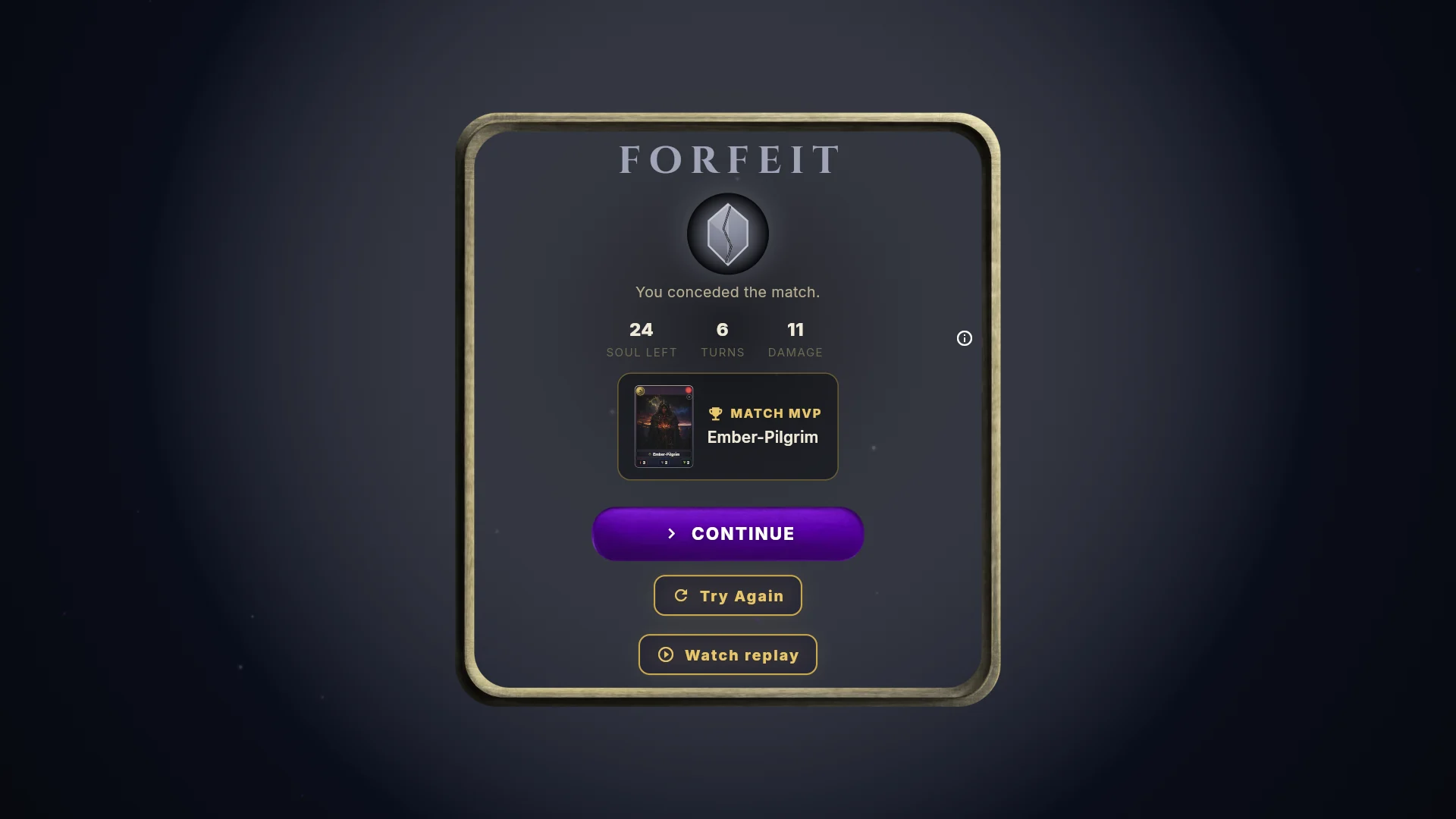
- Conceding counts as a loss. In PvE you still earn a small consolation reward, except that surrendering pays no XP or quest progress.
Reading the battle screen
| Element | What it tells you |
|---|---|
| Name plates (top and bottom) | Each side's Soul bar (current/max) and Aether orb (left/total). The flag button on the right of the enemy plate is how you concede. |
| Deck and discard piles | Small card stacks at the corners with a count of cards left. |
| Lane bonus tags | "+1 ATK", "NEUTRAL" and "+1 DEF" under the enemy row. |
| Phase tracker | Whose turn it is, the turn number, and the current phase. |
| Foe's turn log | "Foe's turn, 2 plays": tap it to read exactly what your opponent did. |
| Rewind button (R1, R2…) | Watch the round you just played again. It appears only while there is a round to rewind and you're idle. |
| Speed (1x) | Speed up combat animations. |
| KILL badges | A forecast that this unit will destroy what it faces this combat. |
| End button | Ends your turn and shows the Soul damage you're about to deal ("−2 SP"). |
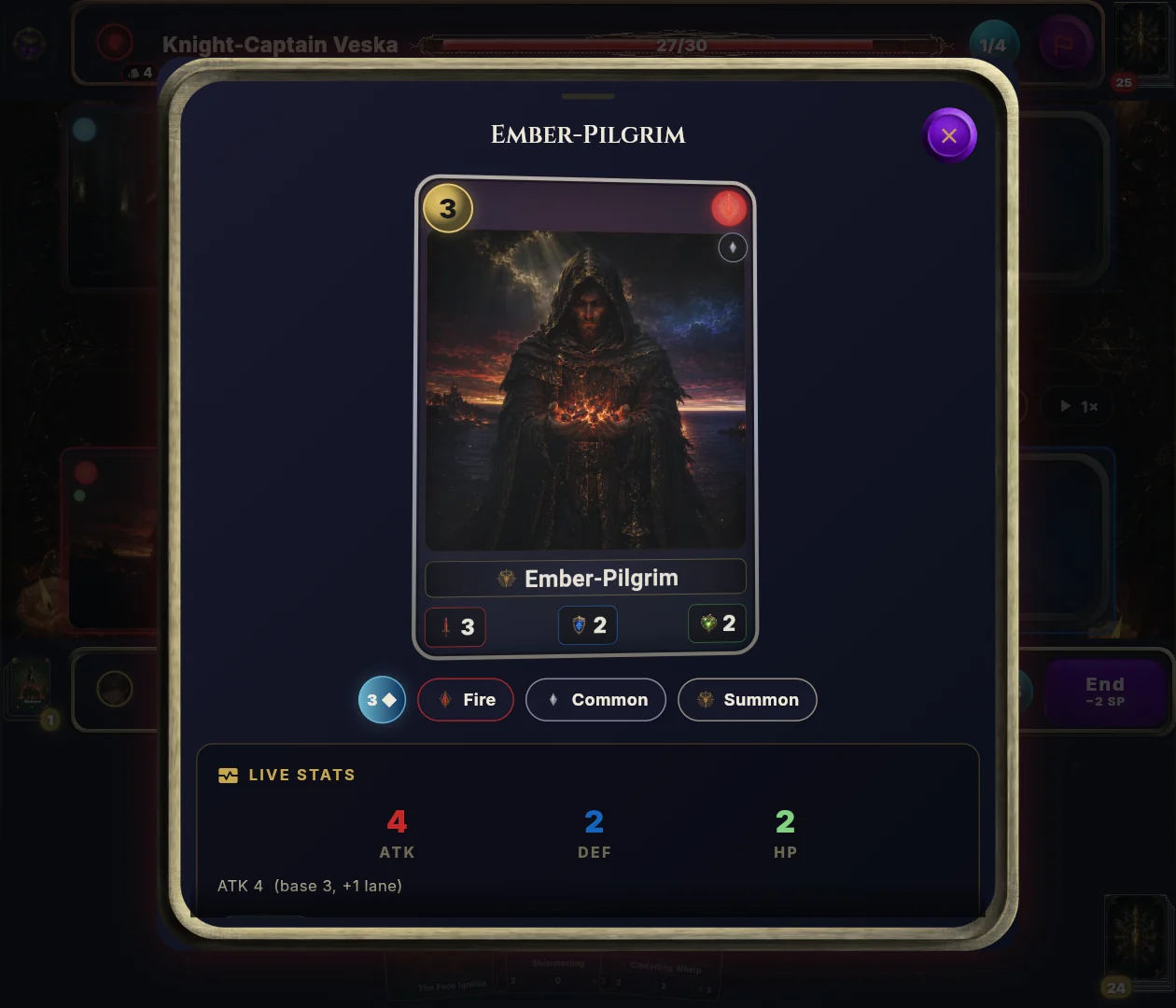
| Card inspector | Tap a unit or press and hold a card to read it in full, including live stats ("ATK 4, base 3, +1 lane"). |
Learn in the game
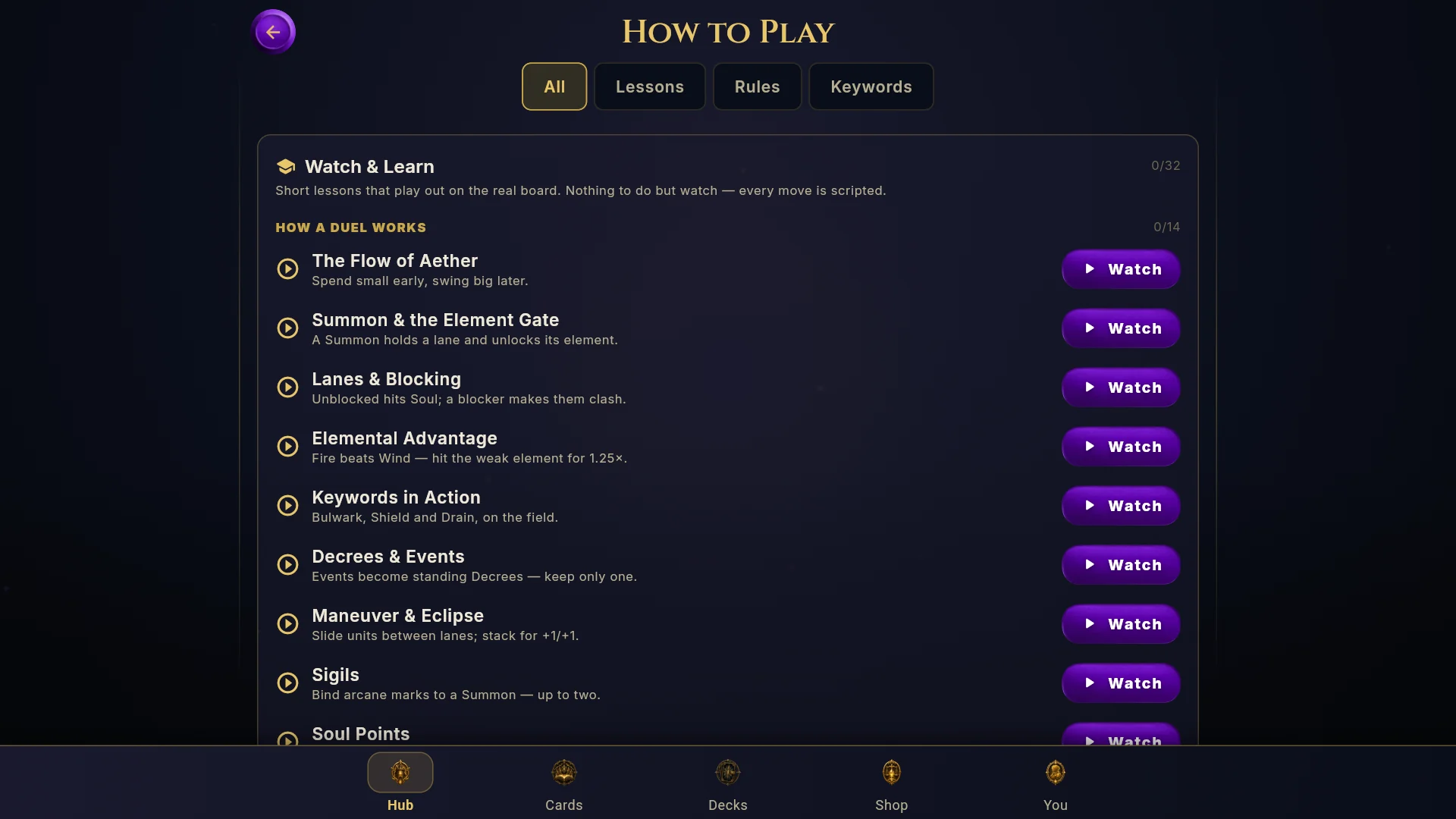
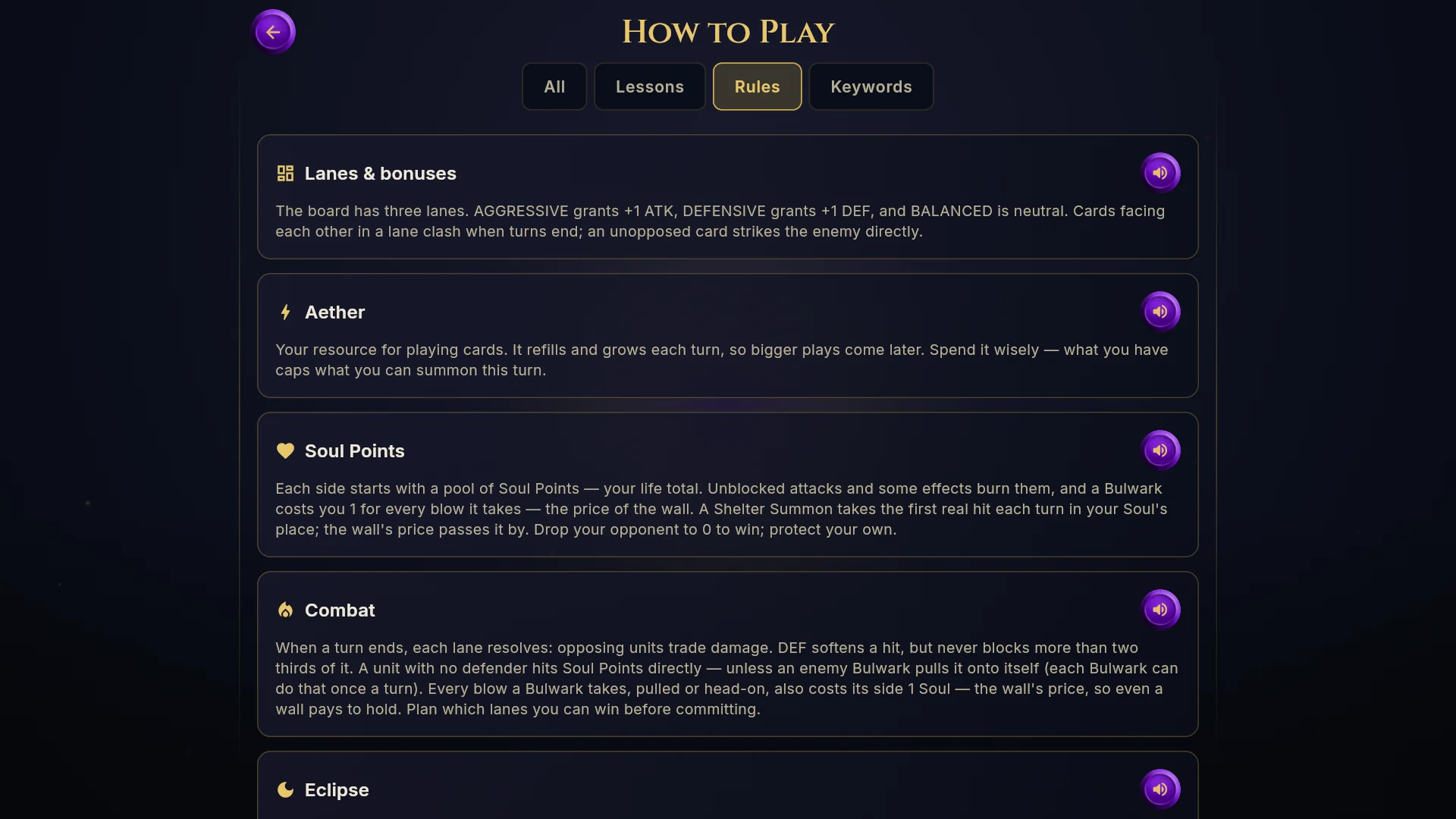
The game teaches all of this itself. Open How to Play from the graduation cap button on the hub, or from the concede menu during a battle. It has three tabs:
- Lessons: 32 short "Watch & Learn" lessons that play out on a real board, from The Flow of Aether to Silence. See the full list.
- Rules: the rules in brief, the same ones on this page.
- Keywords: every keyword's reminder text, the same as our Keywords page.