
Keywords & Statuses
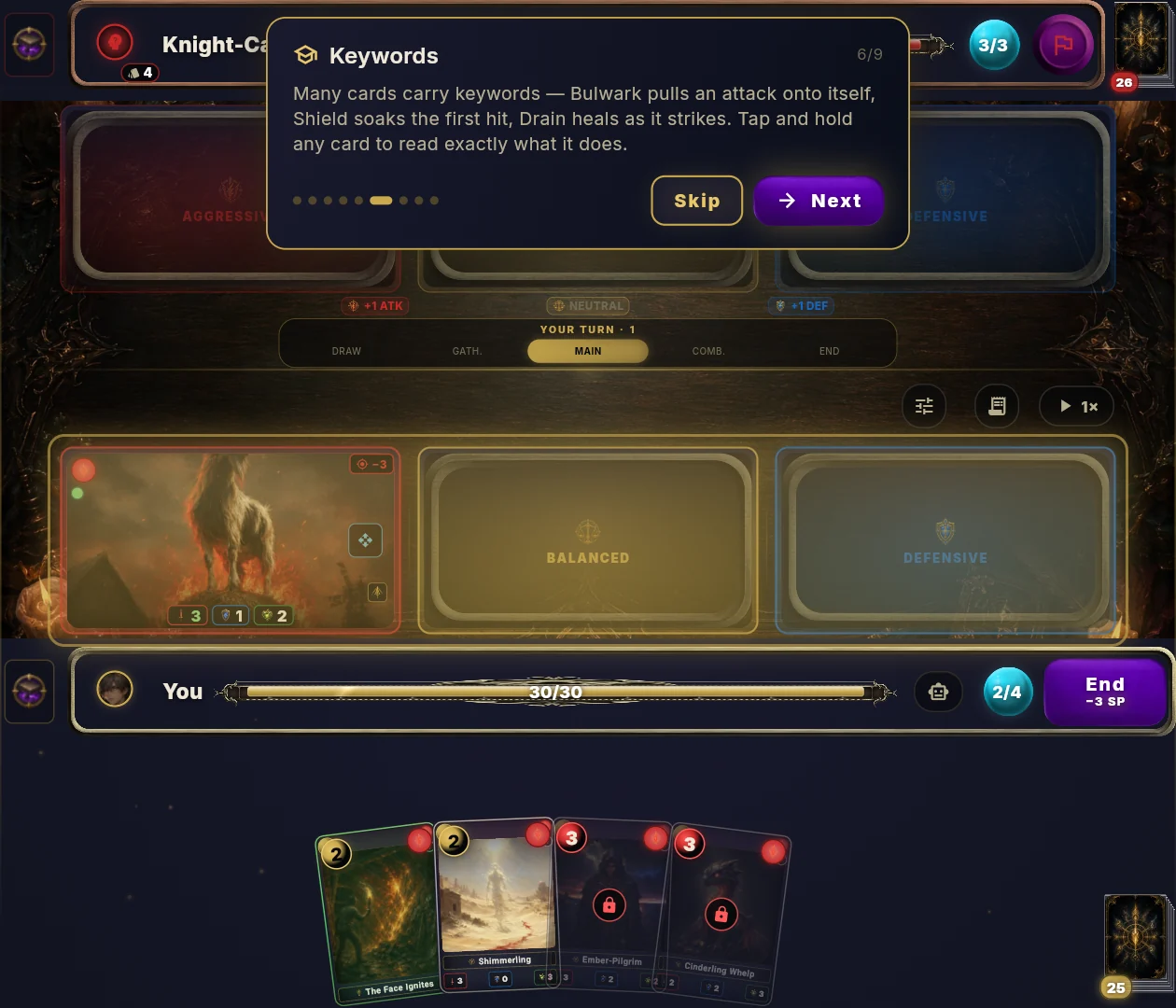
Keywords are short rules printed on cards. There are 29 of them. Each entry below quotes the in-game reminder text, then explains how it plays out in a real match. Tap and hold any card in the game to read its keywords, or open a card in the Card Database.
In battle, press and hold a card in your hand, or tap a unit on the board, to open the card inspector. It lists every keyword on that card with the same reminder text you see here.
All keywords at a glance
| Keyword | Group | Cards |
|---|---|---|
| Vanguard | Attack and timing | 123 |
| Pierce | Attack and timing | 75 |
| Bane | Attack and timing | 47 |
| Stampede | Attack and timing | 12 |
| Undertow | Attack and timing | 40 |
| Radiance | Attack and timing | 43 |
| Unseen | Attack and timing | 92 |
| Bulwark | Defense and protection | 129 |
| Guard | Defense and protection | 72 |
| Shield | Defense and protection | 77 |
| Shelter | Defense and protection | 34 |
| Bramble | Defense and protection | 26 |
| Bedrock | Defense and protection | 46 |
| Crest | Defense and protection | 24 |
| Requiem | Life and death | 50 |
| Respawn | Life and death | 14 |
| Resurface | Life and death | 31 |
| Ephemeral | Life and death | 25 |
| Solitary | Life and death | 22 |
| Burn | Damage over time | 37 |
| Toxin | Damage over time | 51 |
| Invocation | Cards, hand and resources | 331 |
| Augury | Cards, hand and resources | 64 |
| Drain | Cards, hand and resources | 84 |
| Pinch | Cards, hand and resources | 14 |
| Tithe | Cards, hand and resources | 5 |
| Wake | Cards, hand and resources | 54 |
| Ensemble | Cards, hand and resources | 5 |
| Loaded | Cards, hand and resources | 6 |
| Rally | Cards, hand and resources | 0 |
Attack and timing
Keywords that change when and how a Summon attacks.

Vanguard123 cards
In game: Can attack the turn it is summoned.
In practice: A Summon normally sits out the turn it lands. Vanguard lets it attack right away, so it can trade or push damage before your opponent answers.
Examples: Castanet Quail, Spire Courier, Wyvern-Rider, The Weir-Breaker. See all 123 →

Pierce75 cards
In game: The defender never strikes back at it: no counter-blow, even when the defender survives.
In practice: Pierce is stronger than a typical "first strike": the defender never hits back, even when it survives the blow. Attack big blockers with it freely.
Examples: Wyvern Fledgling, Mirage Rider, Harrier of the Spires, One-Combo Berserker. See all 75 →

Bane47 cards
In game: When attacking an elemental-disadvantaged foe, doubles its strike on top of the elemental bonus.
In practice: The doubling applies after the 1.25× elemental bonus, so a 4 Attack Bane Summon hitting a weak element deals 4 × 1.25 × 2 = 10. Counter-blows are never doubled.
Examples: Charge-Setter, Dragonlance Knight, Cinder-Shape, Hollowcrown, Who Came Through the Door. See all 47 →

Stampede12 cards
In game: On destroying a Summon by attacking, the overkill hits enemy Soul Points.
In practice: When it destroys a Summon by attacking, the damage left over goes straight to the enemy Soul Points. Big Attack plus Stampede punishes small blockers. It is printed in the card text (and some cards grant it for a turn), not shown as a keyword emblem.
Examples: Thunder-Stepper, Overrun, Thunderfoot Titan, Frill-Storm Matron. See all 12 →

Undertow40 cards
In game: Instead of attacking, returns the facing Summon (cost no higher than this) to its owner's hand, or destroys it if their hand is full.
In practice: Undertow spends the attack: the unit does not strike Soul Points afterwards, even though the lane is now empty. It only drags back foes that cost the same or less. If their hand is full, the foe is destroyed instead, which Pinch makes much more likely.
Examples: Bail-Crew, Tide-Runner, Drown-Cut Reaver, Maelwyrm. See all 40 →

Radiance43 cards
In game: Attack equals the number of cards in your hand.
In practice: Printed Attack is 0. Attack is recalculated every time it is read, so playing cards out of your hand makes it weaker and drawing makes it stronger. Other Attack bonuses still add on top.
Examples: Firstspark Mote, Hearth-Cub, Haloed Pilgrim, Dawn Censer. See all 43 →

Unseen92 cards
In game: Spells and effects cannot target it, and the strike that reveals it takes no counter-blow. Attacking ends it.
In practice: Untargetable by spells and effects and invisible to Wake, and its first attack takes no counter-blow. An Unseen Bulwark does not pull attacks. The enemy facing it in its own lane can still fight it. Attacking reveals it, after which it is an ordinary Summon.
Examples: Candle Thief, Zephyr Scout, Cornet Kestrel, Vairya, the Stormvoiced. See all 92 →
Defense and protection
Keywords that stop, soak or redirect damage.

Bulwark129 cards
In game: Once each turn, pulls one unblocked enemy attack from anywhere on the board onto this Summon, even one aimed at a Guard. Every blow it takes costs your Soul 1.
In practice: Each Bulwark can make one interception per turn, so two Bulwarks are needed to cover two open lanes. A Bulwark that simply faces the attacker in its own lane spends nothing. The wall's price: every blow a Bulwark takes, pulled or head-on, costs its side 1 Soul Point. An ordinary blocker stops a blow for free.
Examples: Fern-Valley Grazer, Grief-Mason, Quarry-Vault Croupier, Colossus of the Pale Vigil. See all 129 →

Guard72 cards
In game: Cannot be attacked while a DIFFERENT Bulwark ally can still intercept this turn. Its own Bulwark never counts, and spells still hit it.
In practice: Guard pairs with Bulwark: the Guard cannot be attacked while a different Bulwark on your side still has its interception available this turn. A card with both Bulwark and Guard never protects itself. Spells and effects can still hit a Guard.
Examples: Sill-Sitter, Wax Warden, Tutorial Boss, Deepstone Bulwark. See all 72 →

Shield77 cards
In game: Absorbs the first hit from a Summon: a strike, a counter-attack or a Requiem. Spells, Burn and Toxin still land.
In practice: Shield only stops combat hits from Summons: one strike, counter-blow or Requiem. Spells, Burn and Toxin still land, and once the shield pops it is gone.
Examples: Sunlit Pilgrim, Orderbound Knight, Aurum Drake, Sunscale Wyrm. See all 77 →

Shelter34 cards
In game: Once a turn for your whole side, the first damage your Soul would take hits this Summon instead. The 1 Soul a Bulwark costs per blow passes it by.
In practice: Once per turn for your whole side, not once per Summon, the first damage aimed at your Soul Points hits the Shelter Summon instead (the first one in lane order, Aggressive first, if you have several). It can die doing so. The 1 Soul a Bulwark costs per blow is not damage, so Shelter lets it pass.
Examples: Puddle-Wary, Lamp-Room Keeper, The Burning Wagon, Biscuit, Who Holds the Floor. See all 34 →

Bramble26 cards
In game: When a Summon strikes it, reflects half that damage (rounded up) back to the attacker.
In practice: Bramble only works while defending, only on damage that actually landed (a Shield absorb counts as zero), and rounds up: a 1 damage hit reflects a full 1.
Examples: Hatchling Herd, Bramble Druid, Tarpit Lurker, Graven King Orvath. See all 26 →

Bedrock46 cards
In game: While buried, the ally above it gains +1 DEF.
In practice: Bedrock rewards being buried. While another of your Summons is placed on top of it (an Eclipse), the Summon above gets +1 Defense.
Examples: Cellar Runt, Snow Golem, Foundation Cat, Deepvalley Monolith. See all 46 →

Crest24 cards
In game: In its bonus lane, gains an extra +1 to that stat.
In practice: Crest stacks with the normal lane bonus. An attacker with Crest in the Aggressive lane gets +2 Attack instead of +1; a defender in the Defensive lane gets +2 Defense.
Examples: Rib-Packer, Snowmane Charger, The Tonnage Agent, Maelstrom of the Sunken Court. See all 24 →
Life and death
Keywords that fire when a Summon is destroyed, or keep it coming back.

Requiem50 cards
In game: On destroy, deals ATK damage to the enemy facing its lane: or to their Soul Points if that lane is empty.
In practice: The empty-lane half wins games: if nothing faces it when it dies, the damage goes straight to the enemy Soul Points. Trading a Requiem Summon into an open lane is a common finisher.
Examples: Fuse Runt, Bone-Roost Drake, Fen-Revenant, The Ember-Usurer. See all 50 →

Respawn14 cards
In game: When destroyed, returns to your hand instead of the discard pile (discarded as normal if your hand is full).
In practice: Each time it dies it comes back to your hand, and you pay its full cost again to redeploy it. If your hand is full it is discarded instead.
Examples: Fresh Spawn, Save-Scummer, The Griefer, What the Air Brought Back. See all 14 →

Resurface31 cards
In game: Rises from being buried with a permanent +1/+1.
In practice: When the Summon buried on top of it leaves, a Resurface unit rises back with a permanent +1/+1. Burying onto it is a way to grow it.
Examples: Tomb-Sleeper, Jackal of the Tomb, Strata-Chapter Deputy, Bone-Tyrant of the Tar. See all 31 →

Ephemeral25 cards
In game: Returns to hand at end of turn (destroyed instead if your hand is full).
In practice: Returns to your hand at the end of your turn, ready to be played again (and to fire any Invocation again). With a full hand it is destroyed instead.
Examples: Half-Through Gobling, The Temp, Air-Course Runner, The Caravan That Never Arrives. See all 25 →

Solitary22 cards
In game: Destroyed at end of your turn if you control another Summon.
In practice: Destroyed at the end of your turn if you control any other Summon. Solitary cards have oversized stats to pay for it, so they shine in a deck that plays one big threat at a time.
Examples: Firedamp Wisp, Mourner in Black, Maelwyrm, Karvaxis, the Kiln Tyrant. See all 22 →
Damage over time
Keywords that keep hurting at the end of every turn.

Burn37 cards
In game: Takes 1 damage at the end of EVERY turn: yours and the enemy's, so it loses 2 health each round.
In practice: Burn ticks at the end of both players' turns, so a Burn Summon loses 2 Health per round. A Summon with 2 Health and Burn but no Vanguard dies before it ever attacks, which is why Burn usually comes with Vanguard.
Examples: Fuse Runt, Ash Moth, Slag-Eater, Thaw-Golem. See all 37 →

Toxin51 cards
In game: This card deals in poison: it applies Toxin, or is paid off by it.
In practice: Printed Toxin marks a card that applies poison or rewards it. A poisoned Summon takes damage equal to its Toxin stacks at the end of every turn (both sides). Stacks build up, never fade on their own, and only a cleanse removes them.
Examples: Grit in the Lung, Rotgut Pilgrim, Spreading Blight, The Fen Rises. See all 51 →
Cards, hand and resources
Keywords about drawing, hand size, cost and dice.

Invocation331 cards
In game: Triggers an effect when summoned.
In practice: The most common keyword in the game. The effect is written on the card and happens once, when the card is summoned. Ephemeral and Respawn cards can fire their Invocation again by being replayed.
Examples: AFK Fisher, The Pallbearer's Bet, Spine-Row Matriarch, Warden-Marshal Bren. See all 331 →

Augury64 cards
In game:
In practice: Draws at the end of your turn. If your hand is already full, the drawn card is scorched (lost), so watch your hand size.
Examples: Snow-Hare, Vigil-Chorister, The Endless Thread, Dawn-Warren Marshal. See all 64 →

Drain84 cards
In game: Heals you for damage dealt.
In practice: Every point of damage this unit deals heals your Soul Points by the same amount, so Drain units swing races.
Examples: Bilge Rat, Sewer-Gate Smuggler, Pact-Bearer of the Veiled, Marlow, Who Waited Out the Flood. See all 84 →

Pinch14 cards
In game: While in play, the enemy hand holds 1 fewer card (stacks). Never forces a discard.
In practice: Each Pinch Summon lowers the enemy hand limit by 1 (they stack). It never makes anyone discard; a player over the new limit simply cannot draw until they are under it. A smaller hand also makes Undertow, Respawn and Ephemeral bounces fail into destruction.
Examples: Wall-Presser, Grindspark, Deadwork, The Flame That Walked. See all 14 →

Tithe5 cards
In game: You may pay this many of your own Soul Points to summon it for that much less Aether. Never offered if paying would leave you at zero.
In practice: Always optional: you can still pay full Aether. Each Soul Point you pay saves 1 Aether. The game never offers a Tithe that would take you to zero, and because it is a price rather than damage, Shelter cannot intercept it.
Examples: Tithe-Taker of Vael, Coalwall Oblate, The Ember-Usurer, Blaze Knight of the Ashen Vow. See all 5 →

Wake54 cards
In game: On Maneuvering into a lane, deals 1 to the foe facing it (an Unseen foe cannot be found).
In practice: Wake triggers when the Summon Maneuvers (moves) into a lane, dealing 1 damage to the enemy facing that lane. An Unseen foe cannot be hit by it.
Examples: Tin-Whistle Wren, Glint-Scout, Kite Wraith, Saltwind Corsair. See all 54 →

Ensemble5 cards
In game: While you control enough other Summons, gains bonus stats (some also gain Pierce).
In practice: Ensemble cards (the Birdwell band) get the bonus printed on them while you control enough other Summons. Some also gain Pierce. Go wide to turn them on.
Examples: Handbell Finch, Snare-Drum Starling, Fiddler of the Hedgerow, Piping Vanguard. See all 5 →

Loaded6 cards
In game: While in play, add +1 to every WAGER die you roll (sources stack).
In practice: Loaded works with Wager dice (Fate's Gambit). Each Loaded source on your side adds +1 to every Wager die you roll, and multiple sources stack.
Examples: Wheelwright of Fates, Loaded Die, Marked-Deck Mystic, Madame Meridienne, Wheel-Seer. See all 6 →

Rally0 cards
In game: Costs 1 less for each ally on field.
In practice: Rally lowers a card's cost by 1 for each ally you control. No card in the current card pool carries Rally.
Unit statuses
Statuses are states a unit is in right now, shown as small marks on the board and as chips in the card inspector. Tap any mark to read what it means.

Ready
Not exhausted: it will strike at the end of your turn. A ready unit you haven't moved yet shows a small corner grip, so you can drag it to Maneuver.

Exhausted
Won't strike this turn and can't Maneuver. New Summons (unless they have Vanguard), units that just moved, units that already attacked and units that just rose from burial are exhausted. Marked with a "zzz". In game: "Has already acted this turn: it can't attack or Maneuver again until it readies."

Maneuvered
Moved lanes this turn. Each unit can move once per turn, and the inspector shows "Maneuvered, won't strike" unless the move kept it ready.
Burning
Takes 1 damage at the end of every turn, both yours and your foe's. Some cards can put the fire out.
Poisoned (Toxin stacks)
A spinning venom drop shows the number of stacks. "At end of turn, takes damage equal to its Toxin stacks (they never wear off)." Healing doesn't remove them; only a cleanse does.

Shielded
The next hit from a Summon (a strike, a counter-blow or a Requiem) is absorbed completely, then the shield is gone. Spell damage, Burn and Toxin go straight through.

Silenced
"All of this Summon's keywords and abilities are suppressed while silenced: it fights as a plain body." Silence also strips Shield and Unseen. Granting the unit a new helpful keyword lifts it.

Unseen
Can't be targeted by spells or effects and can't be hit by Wake. Its first attack takes no counter-blow, and attacking reveals it.

Buried
Entombed beneath another of your units after an Eclipse. A buried unit can't attack, block or be targeted. When the unit on top leaves, it rises at the Health it had, exhausted for a turn. The inspector shows it under "Eclipsed, beneath".
Other board marks
- Guard ward: a sapphire Bulwark emblem on a Guard means a different Bulwark is protecting it this turn. The inspector says "Sheltered by Bulwark" or "Guard exposed".
- Shelter ready / spent: whether your side's once-a-turn Shelter absorb is still available.
- Growth ring: units that grow every turn show a ring filling toward the +6 cap, with a gold pulse when it tops out.
- Solitary warning: a cyan chip on a Solitary unit that will fall at your end step because you control another Summon.
- Sigil pips: one mark per Sigil bound to the unit (up to two). Tap to read the Sigil.
- KILL badge: a forecast that this unit will destroy what it faces in this combat.