
Deckbuilding
Every deck is exactly 30 cards. The game gives you a lot of help building them: a guided workshop, an Auto-build engine with 18 plans, 10 ready-made Recipes, and an editor that grades your deck as you go.
See Best Decks: four tested builds with deck codes you can paste straight into the game, including a budget deck made only of Commons, Uncommons and Rares.
Deck rules
- You must own every copy you put in a deck.
- There's no element limit. Mix as many elements as you like, but remember the element gate: Spells, Events and Sigils need a Summon of their element on your side.
- The deck tile shows "READY 30/30" when a deck is legal. Otherwise the editor tells you exactly what's wrong: "Need 2 more cards.", "Max 2 copies of Volcanic Rite.", "4 Mythics: the limit is 3. Remove 1.", and so on.
The Decks screen
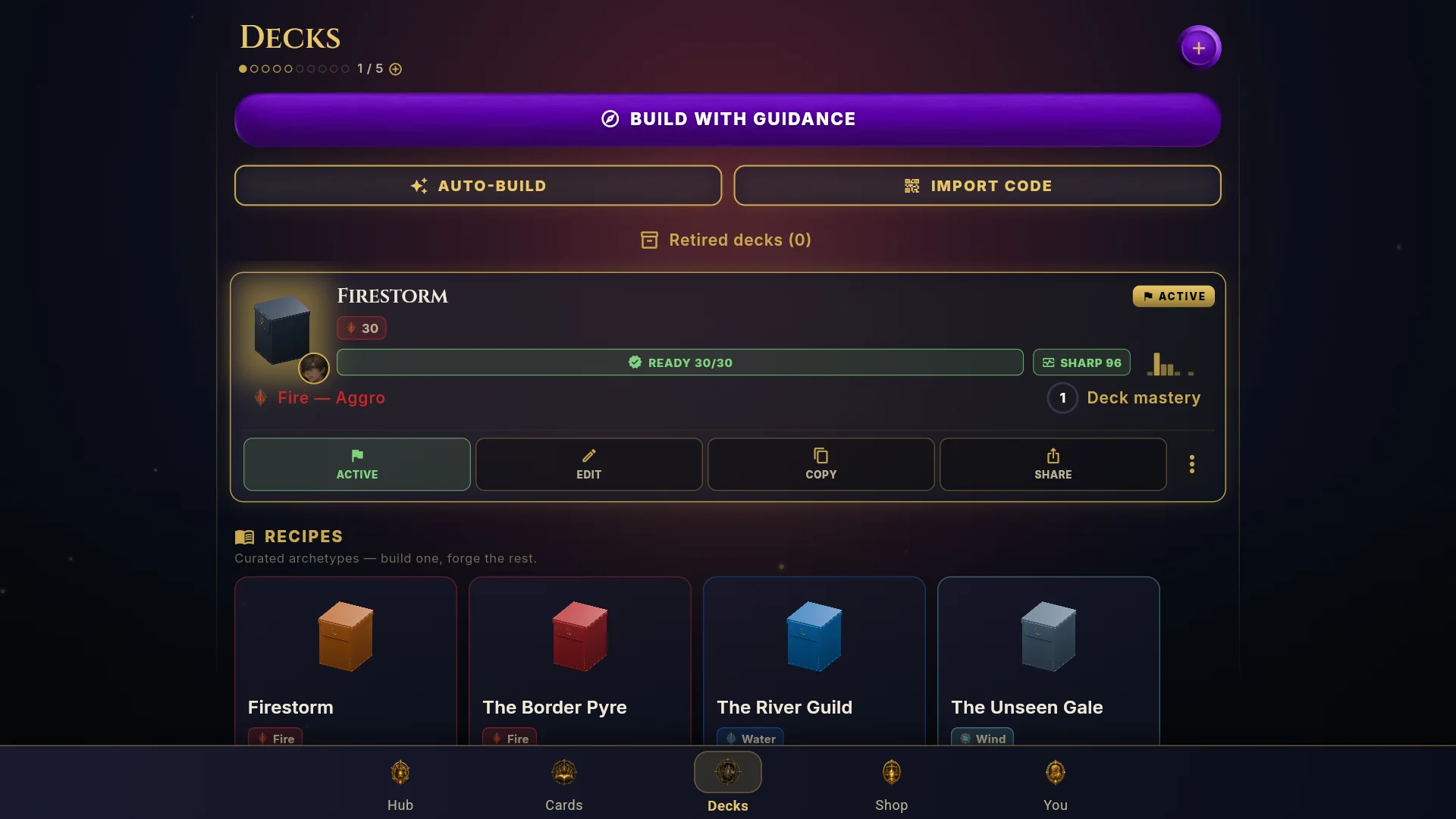
- Deck slots: 5 free. You can buy up to 5 more with gems (10 in total). Each extra slot costs double the last: 100, 200, 400, 800, then 1,600 gems.
- Active deck: the deck you take into battle by default. Tap Activate on another deck to switch.
- Each deck tracks its own wins, losses and draws and a Deck Health score.
- Deck menu: copy, share a deck code, pin to top, rename, notes and tags, compare with another deck, reset record, delete.
- Retire instead of delete: retiring a deck frees its slot but keeps its record and cosmetics, so you can restore it later.
Four ways to build
1. Build with Guidance (the Aether Workshop)
A three-step guided builder. Choose a route:
- Start with a theme: "Find a playstyle, see supporting cards you own, and build a balanced draft around it."
- Start with a favorite card: "Choose an owned card. Discover plans that fit its element and the jobs it can do."
It only uses cards you own and nothing is saved until you save in the editor.
2. Auto-build
"Pick a plan; you'll choose from a few candidate decks." The engine builds a full 30-card deck from your collection toward the plan you pick, then shows you a few different takes on it, each with its curve and synergy packages. Tap one and Use this deck.
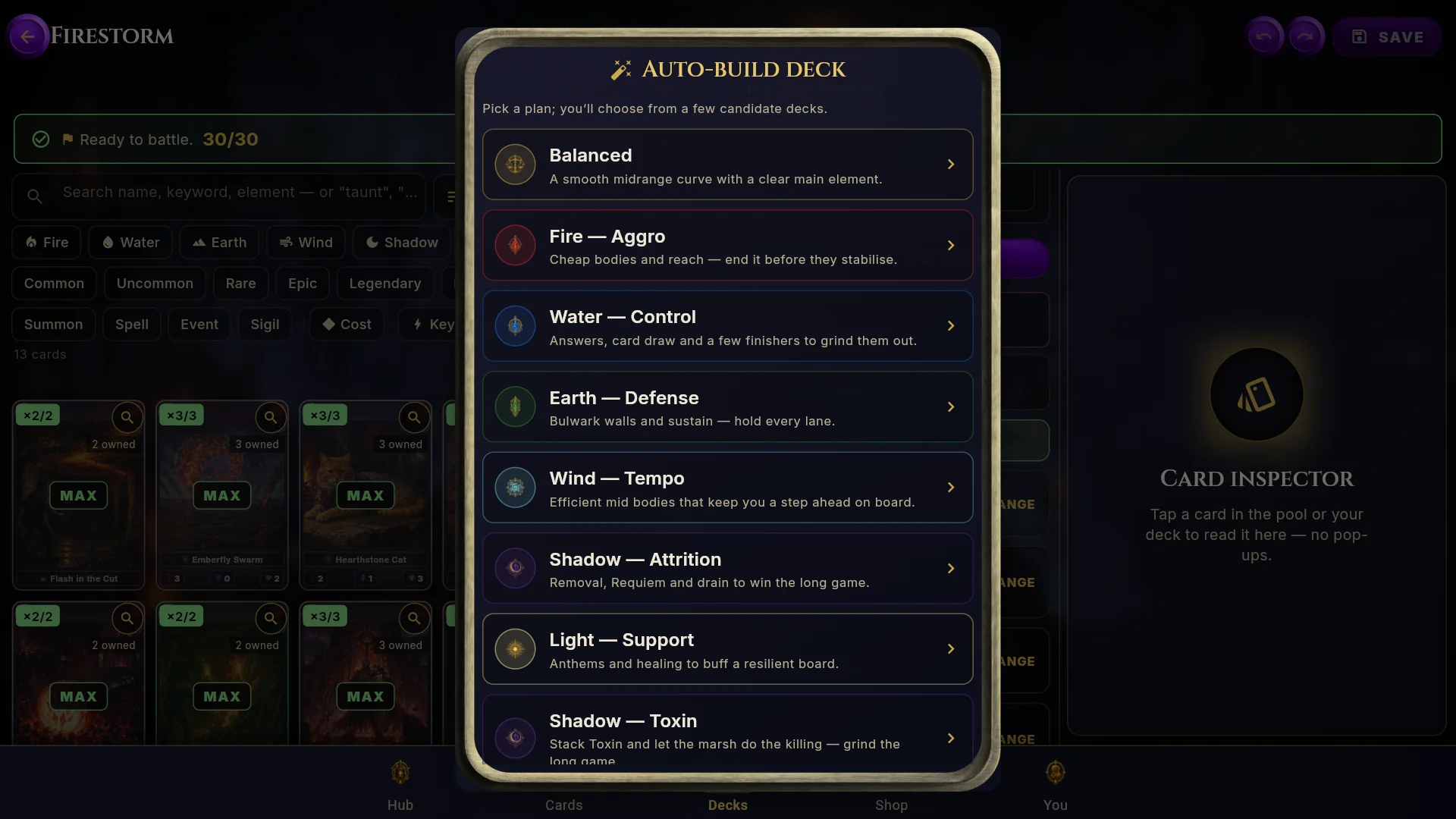
| Plan | What it does |
|---|---|
| Balanced | A smooth midrange curve with a clear main element. |
| Fire: Aggro | Cheap bodies and reach: end it before they stabilise. |
| Water: Control | Answers, card draw and a few finishers to grind them out. |
| Earth: Defense | Bulwark walls and sustain: hold every lane. |
| Wind: Tempo | Efficient mid bodies that keep you a step ahead on board. |
| Shadow: Attrition | Removal, Requiem and drain to win the long game. |
| Light: Support | Anthems and healing to buff a resilient board. |
| Shadow: Toxin | Stack Toxin and let the marsh do the killing. |
| Light: Radiance | Draw and hold a full hand; Radiance turns every card into Attack. |
| Wind: Ensemble | Flood the board, then let the whole band play as one. |
| Earth: Stampede | Overrun their line: trample damage spills over into Soul Points. |
| Water: Undertow | Bounce their board to hand and strike the empty water. |
| Gambit: Wager | Press your luck: every Wager pays, and Loaded dice pay the most. |
| Respawn: Recursion | Bodies that come back to hand: trade freely and redeploy all game. |
| Shelter: Bodyguard | Small defenders that take the hit for you: outlast their reach. |
| Shadow: Pinch | Squeeze their hand shut, then bounce their board into the gap. |
| Wyrm: Solitary New | Clear the mountain, then land a wyrm that will not share it. |
| Mirage: Tomb New | Stand a mirage on a tomb each turn: when it fades, the tomb rises. |
The same 18 plans are the opponents you can pick in Practice, so you can test a deck against exactly the kind of deck you're worried about. Inside the editor, Finish my deck keeps the cards you've chosen and fills the gaps.
3. Recipes
"Curated archetypes: build one, forge the rest." Ten hand-built decks, each showing how many of its cards you own and the Motes needed to craft the rest. Tap Build deck, then Forge all to craft what's missing.
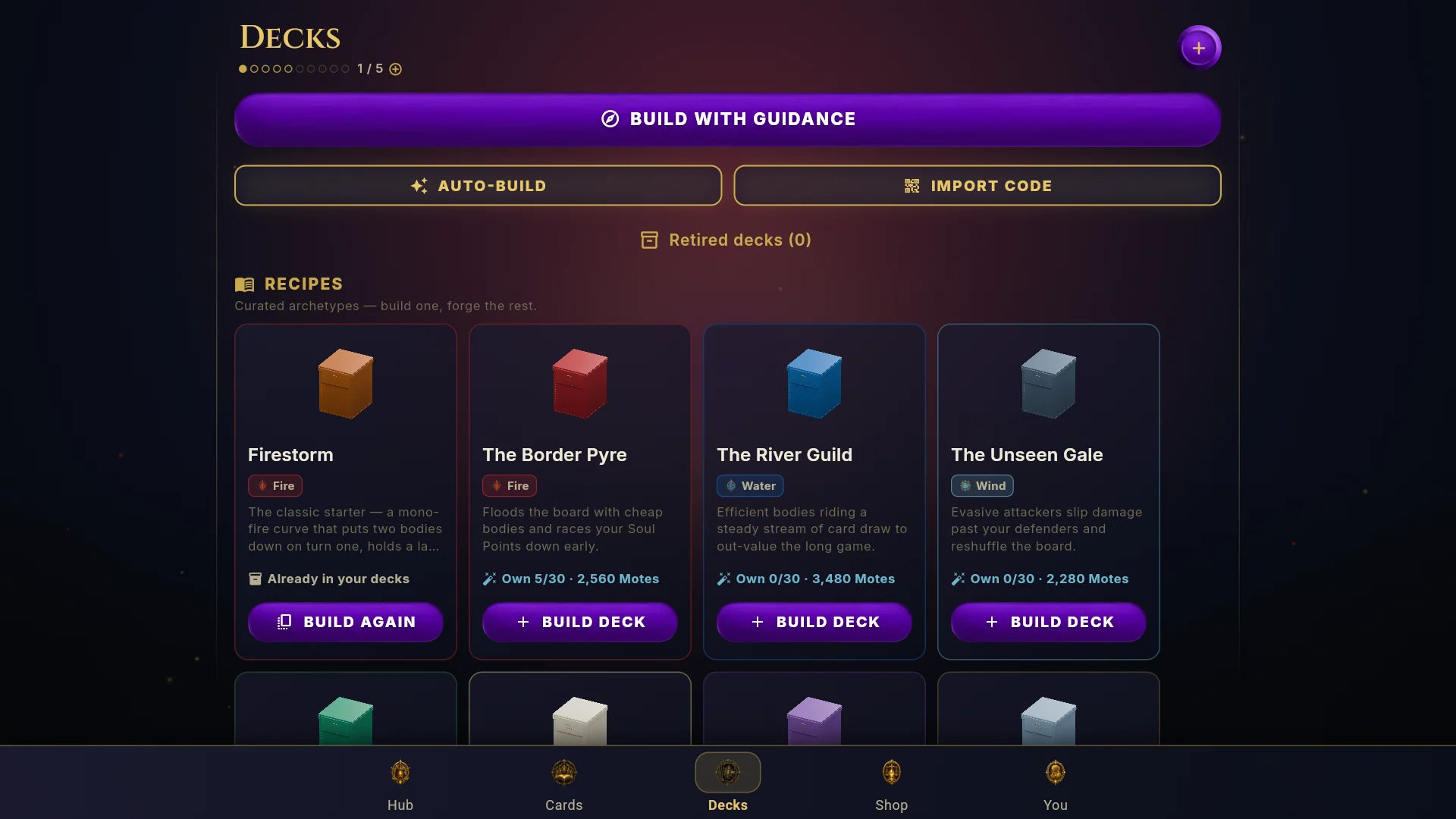
| Recipe | Element | Cards | Motes for a new player* |
|---|---|---|---|
| Firestorm | Fire | Your starter deck | Owned |
| The Border Pyre | Fire | 24 Common, 2 Uncommon, 4 Rare | about 2,560 |
| The Unseen Gale | Wind | 22 Common, 6 Uncommon, 2 Rare | about 2,280 |
| The River Guild | Water | 22 Common, 2 Uncommon, 6 Rare | about 3,480 |
| The Free Company | Mixed | 24 Common, 2 Uncommon, 4 Epic | about 3,480 |
| The Choir of Elar | Light | 16 Common, 9 Uncommon, 5 Rare | about 3,540 |
| The Stoneward House | Earth | 19 Common, 3 Uncommon, 4 Rare, 4 Epic | about 5,860 |
| The Grave Toll | Shadow | 8 Common, 12 Uncommon, 8 Rare, 2 Epic | about 6,320 |
| The Sunken Court | Shadow | includes a Legendary and a Mythic | about 22,500 |
| The Inferno Court | Fire | includes 2 Legendaries and a Mythic | about 26,740 |
* Crafting every card from scratch at craft prices, minus the cards in the Firestorm starter. The real cost is lower once you've opened some packs; the game shows your exact cost live.
4. Import a deck code
Every deck can be shared as a code starting with ACx2:. Tap Import Code and paste one in to rebuild that list. Any cards you're missing can be forged from the editor. Deck codes can also be sent to friends in direct messages, where they show up as a tappable deck chip.
The deck editor
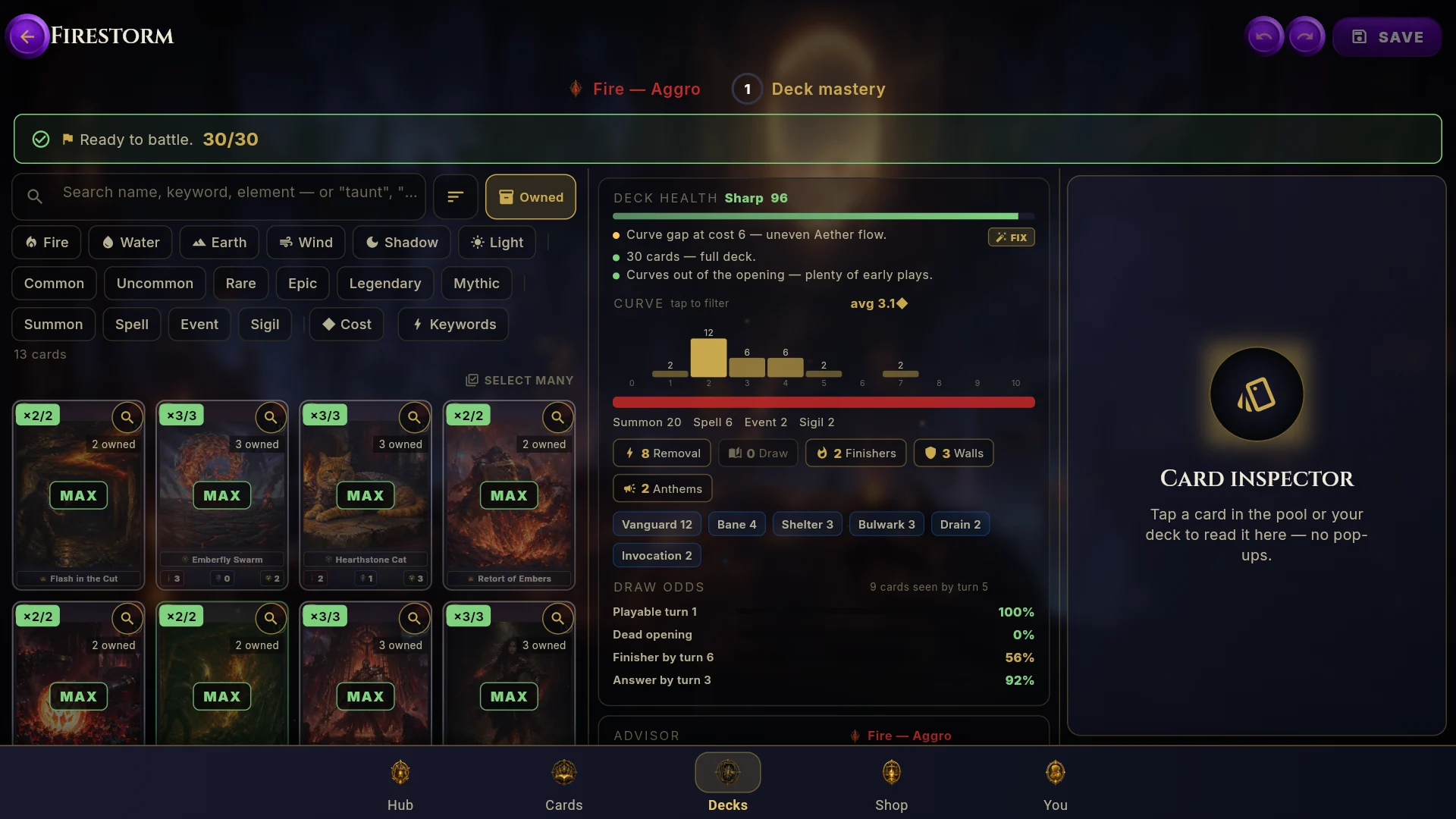
- Card pool: search by name, keyword, element, or plain words like "taunt" and "wall". Toggle between owned cards and all cards, filter by element, rarity, type, cost and keyword, and use Select many to add several at once.
- Forge in place: unowned cards can be crafted right from the editor ("Forge · N Motes").
- Undo, redo, Revert, Clear and Auto-name (it names the deck for you).
Deck Health
Every deck gets a score from 0 to 100: Sharp (85+), Solid (70+), Fair (50+) or Rough (under 50). It docks points for common mistakes and tells you how to fix them:
| Problem | Penalty |
|---|---|
| Missing cards (under 30) | up to −30 |
| Summons make up less than half the deck | −14 |
| Slow start: too few cards costing 1 to 3, or fewer than 4 two- and three-drops | −16 |
| Top-heavy: over 30% of cards cost 7 or more | −12 |
| Four or more elements and no clear main element | −12 |
| Average cost above 5.0 (or below 2.3) | −10 (−6) |
| Guards with no Bulwark to protect them | −8 |
| Gaps in the curve | −4 each, up to −12 |
Curve, roles and draw odds
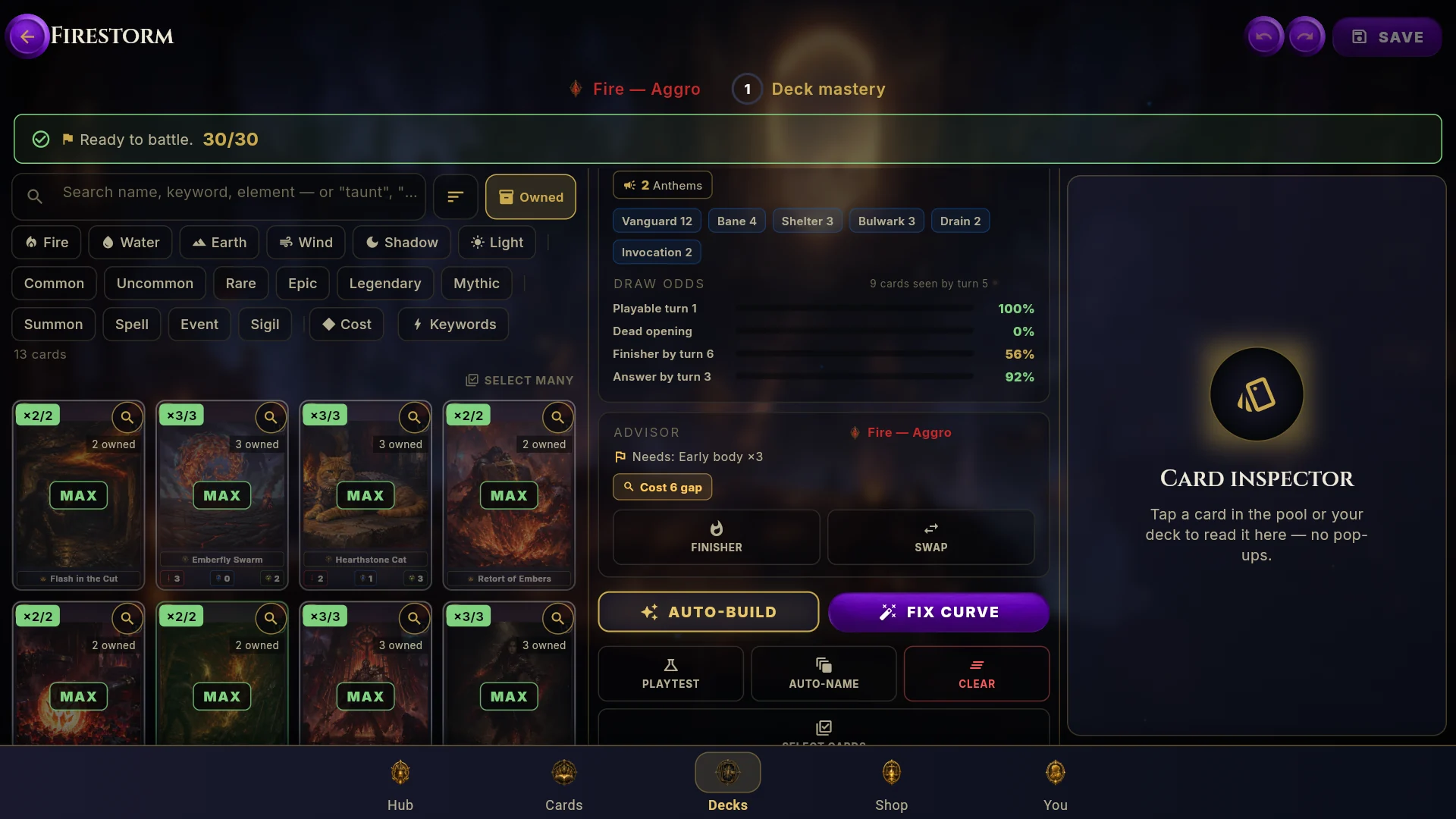
- Curve chart: how many cards you have at each cost, and the average.
- Role pills: counts of Removal, Finishers, Walls, Guards, Sustain and Anthems, plus how many of each keyword you run.
- Draw odds: the exact chance of things like "Playable turn 1", "Dead opening", "Finisher by turn 6" and "Answer by turn 3", calculated from your real 30 cards.
- Advisor: suggestions for what your deck needs ("Needs: Early body ×3", "Cost 6 gap"), with Fix Curve to repair it automatically using cards you own.
- Playtest: deals you a real opening hand and lets you draw turn by turn, or jump straight into a real duel.
Deck cosmetics
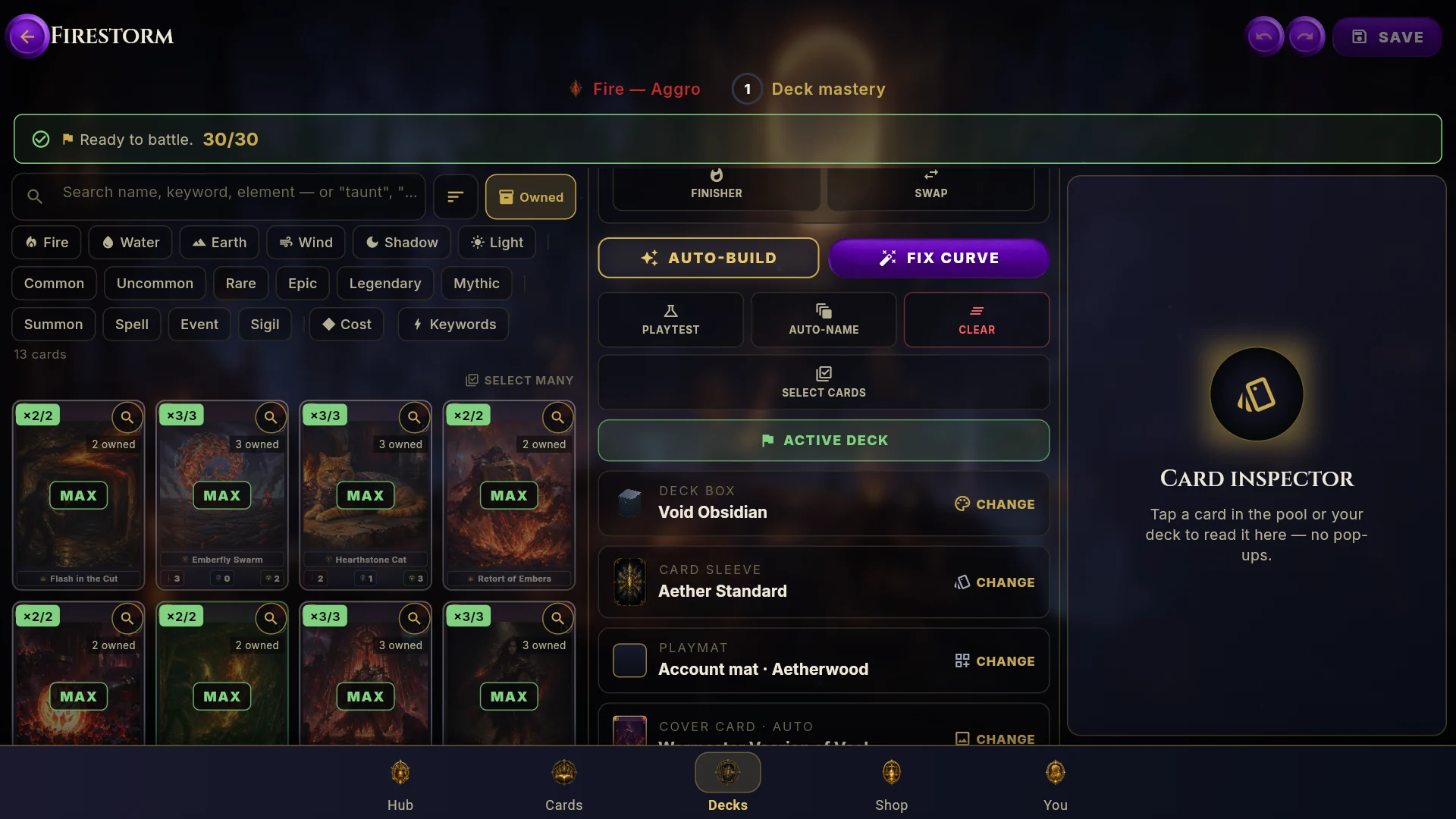
Each deck can have its own deck box, card sleeve, playmat (or follow your account mat) and cover card (pick one, or let it auto-pick your rarest card). See Cosmetics.
Deck mastery
Each deck earns mastery as you play it: 2 points for a win and 1 point for any other finished match. Mastery levels unlock cosmetics for that deck:
| Level | Points | Reward |
|---|---|---|
| 2 | 10 | The Artisan Vault deck box |
| 3 | 30 | The Administrator playmat (otherwise a 1,000 gem Mythic mat) |
| 4 | 60 | The Gilded Hand card sleeve |
| 5 | 100 | A Paragon foil nameplate for the deck |
Deckbuilding tips
- Pick one main element, maybe a second. Your Spells, Events and Sigils only work with a matching Summon on the board, so a deck split six ways often holds cards it can't play.
- Run plenty of Summons. Aim for at least 15 to 18 of your 30 cards. Summons hold lanes, deal damage and unlock your other cards.
- Mind your opening. You have 4 Aether on turn one and 5 on turn two. Have enough 2 and 3 cost cards to use it.
- Watch the Decree count. You can only keep one Decree at a time, so two or three Events is usually plenty.
- Pair Guards with Bulwarks. A Guard is only protected while a different Bulwark is beside it.
- Test it. Practice against the plan you expect to face, and use the editor's draw odds before you commit Motes.
More in Strategy Tips.